

Editor’s Note: This article is Part 1 of a three-part Student Affairs Executive series examining how colleges and universities are turning data into evidence of institutional impact. Part 1 explores the shift from documenting activity to demonstrating what changes because of student affairs’ work. In Part 2, we’ll examine what it takes to build a division capable of doing this well — from assessment expertise and leadership strategy to data infrastructure and a culture of evidence. Part 3 will explore the next step: turning evidence into action, including how institutions are using data to identify what isn’t working, intervene earlier and make better decisions on behalf of students.
Eight years of data. Fifteen minutes to make the case.
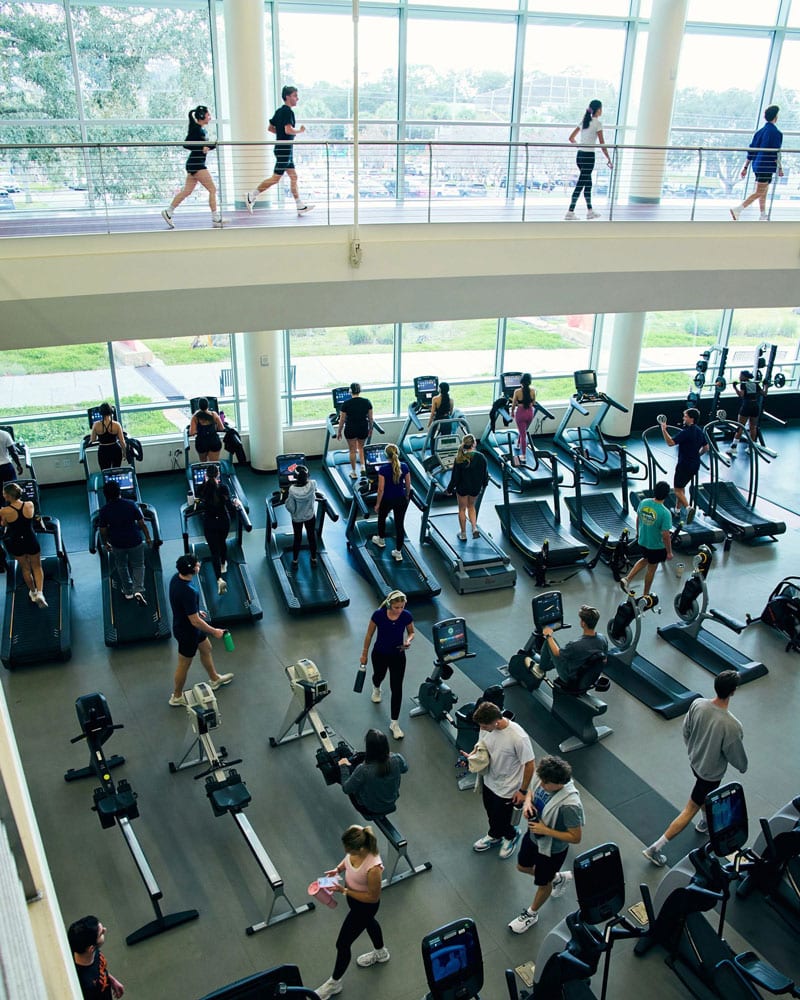
When University of Florida (UF) leaders went before the Board of Trustees to discuss the need for an additional recreation facility, they weren’t simply asking the board to invest in more space for students to exercise. They were making a case for student success.
Behind the presentation were years of data showing who was using UF’s recreation facilities, how frequently they visited and where they lived. There was student feedback showing that some wanted to use the facilities more but were deterred by overcrowding and accessibility. And there were comparisons between recreation engagement and outcomes institutional leaders care deeply about: GPA, retention, graduation and post-graduate employment.
The result was not a claim that going to the recreation center caused students to persist or earn better grades. The data couldn’t prove that. Instead, it built a layered, evidence-based argument that recreation was connected to outcomes far more consequential than how many students walked through the doors.
The presentation lasted roughly 15 minutes. There was little fanfare from the Board during the meeting. What happened afterward was more telling.
“Several board members commented afterwards how much they appreciated the use of data,” said Shaun Boren, the director of Student Life Assessment and Research at UF.
The example offers a glimpse at an increasingly important challenge for student affairs executives.
For years, the field has been adept at demonstrating activity. How many students attended an event? How many counseling appointments were provided? How many students joined an organization? How many times was the recreation center used?
Those numbers tell leaders something important about reach and demand, but they don’t necessarily tell them what changed, or what the impact was. And at a time when colleges and universities are making increasingly difficult decisions about resources, programs and institutional priorities, that distinction matters.
The more consequential question for student affairs is becoming: What difference did the work make?

Building a Case, Not Finding a Number
Boren describes UF’s recreation analysis as something of a “three-legged stool.”
Participation was part of it. A program can promise extraordinary learning or developmental outcomes, but if few students participate, its institutional impact will inherently be limited.
Student feedback added another layer. In the recreation example, students described overcrowding and accessibility challenges that prevented some from using the facilities as often as they wanted. UF’s own research also found that students living closer to the recreation facility used it more frequently.
Then there were the institutional outcomes.
UF compared recreation engagement with measures including GPA, retention and graduation. Rather than simply separating students into users and non-users, researchers examined differences among heavy, medium and light users. Heavier users tended to have stronger outcomes. The university has even examined the relationship term by term, finding that as individual students’ recreation usage changed, GPA tended to move in the same direction on average.
Boren is careful about what that evidence means. “It’s a correlation, not causation,” he said.
The distinction is an important one for a field eager to demonstrate its contribution to retention, academic performance, well-being and graduation. That is because students don’t live in controlled experiments. A university can’t randomly assign one group to participate in recreation, housing or student organizations while prohibiting another group from doing so simply to measure the difference.
Proving value requires multiple forms of credible evidence that, together, reveal a pattern.
UF’s case drew from several sources: usage patterns and student feedback demonstrated demand, while institutional data connected recreation participation with measures of student success. Existing research offered additional context for why those relationships might exist.
Together, those pieces made a much stronger case.
Turning “Belonging” Into Evidence
At the University of Connecticut (UConn), Liza Boritz has been working through a similar challenge from a different direction.
Belonging has become ubiquitous in higher education. It appears in strategic plans, student success initiatives and conversations about retention. There is broad recognition that students who feel connected to their institutions are more likely to have positive college experiences.
Measuring that connection is more complicated.
“We talk about the concept of belonging a lot, but we talk about it at a very high theoretical level,” said Boritz, the director of planning and assessment at UConn.



Boritz has spent years working to better understand and measure the non-academic factors that influence college student success. At UConn, she has connected results from the Student Experience in the Research University (SERU) survey — a national survey administered through a consortium of research universities — with information about students’ actual experiences, including where they live, their GPA, student organization participation, recreation usage and interactions with faculty, staff and other students.
Her work examines which experiences appear connected to whether students feel they belong.
One finding has emerged as particularly important. Students’ reported sense of mattering — the extent to which they feel they are an important member of the campus community — was the strongest predictor in Boritz’s model of overall institutional satisfaction.
From there, leaders can examine which experiences make students feel that they matter, where gaps exist and which parts of the student experience appear to strengthen that connection.
Campus recreation provides one example.
By connecting recreation swipe data with student experience survey responses, UConn found that students who visited the recreation center three or more times per week were more likely to report stronger senses of belonging and mattering, as well as higher overall institutional satisfaction. The analysis also found a small positive relationship with GPA. Similar patterns emerged around participation in student organizations.
The findings allow UConn to tell a different story about recreation. The university can report that its recreation center records hundreds of thousands of visits. But the volume of activity is only part of what the data reveals.
“We don’t fund numbers of students who walk through the door,” Boritz explained. “We fund initiatives that support enrollment, students’ persistence, their mental health, their physical health, and so we have to tie everything we do back to those outcomes.”
A busy recreation center isn’t evidence of impact on its own. Neither is increased membership in a student organization or 450 students attending a leadership program. The value lies in understanding what outcomes are connected to that activity.
Student Affairs Has a Translation Problem
UF and UConn also demonstrate that collecting more data isn’t necessarily the answer.
Universities already generate enormous amounts of it. Making that information useful requires connecting data that may live in different systems, understanding what it can reasonably tell leaders and translating the findings into something meaningful enough to influence a decision.
Boritz describes her own role as an “interpreter.”
“The language of numbers and data and outcomes translated into the meaning of ‘now,’” Boritz said. “What do we have to do as a result of these numbers?”
A dashboard, by itself, doesn’t make an argument. Nor does a retention rate or satisfaction score. Their value depends on understanding how the pieces fit together and what they suggest leaders should do next.
Boren sees the same challenge. Assessment professionals, he said, have historically been viewed as the people who administer surveys or build dashboards. The growing demand for evidence requires something more strategic: people capable of helping leaders determine which questions are worth answering, what evidence is credible and how it connects to institutional priorities.
The work also requires discipline.
Numbers can appear definitive even when the underlying evidence is not. Correlation can be mistaken for causation, and an impressive statistic can become misleading when separated from its context. For student affairs leaders trying to make a stronger case for their work, credibility depends as much on acknowledging those limitations as it does on presenting the findings.
The New Case for Student Affairs
The work of student affairs has always extended far beyond the number of students served.
Housing creates communities. Recreation supports physical and social well-being. Student organizations create relationships and leadership experiences. Career services connects education with employment. Student support programs help remove barriers that might otherwise prevent a student from continuing.
The profession has long understood the breadth of that impact; demonstrating it with credible evidence is becoming increasingly important.
That doesn’t mean every student affairs program needs to prove that it single-handedly increases graduation rates. Nor should leaders search for convenient statistics that validate work they have already decided is valuable.
A stronger case starts with defining the intended impact, identifying the evidence that could demonstrate it, listening to what students say about their experiences and examining which institutional outcomes appear connected. The limitations of the evidence matter, too, as does what leaders decide to do with the information once they have it.
At UF, eight years of information became a 15-minute case before the Board of Trustees. At UConn, hundreds of thousands of recreation visits became evidence in a larger examination of whether students feel they belong and matter to their institution.
Neither institution found one perfect number that proved student affairs’ value. They connected the work to the outcomes their universities are trying to achieve.
For a field accustomed to documenting how much it does, that represents a significant evolution. Participation still matters. Utilization still matters. But the strongest case for student affairs will increasingly be built on evidence that shows how those experiences contribute to student success — and gives institutional leaders something meaningful to act on.
In Part 2, we’ll examine what it takes to build a division capable of doing this well — from assessment expertise and leadership strategy to data infrastructure and a culture of evidence.

With more than a decade of experience in B2B journalism, Rachel Chonko is Editor-in-Chief of Student Affairs Executive and Peake Media. She specializes in connecting leaders with the ideas, strategies and peers that can help them navigate complex challenges and strengthen their organizations.
Through Student Affairs Executive, Rachel works closely with senior student affairs leaders across higher education to explore the issues commanding executive attention — from student success, data and assessment to organizational strategy, financial leadership, technology and stakeholder engagement. Her reporting is grounded in conversations with the leaders doing the work, with an emphasis on practical insights, institutional case studies and peer perspectives.
Rachel also helps shape the Student Affairs Executive Summit, an intimate, discussion-driven event designed to bring senior student affairs leaders together for candid conversations, relationship building and shared problem-solving.
Connect with Rachel on LinkedIn or explore her latest articles.