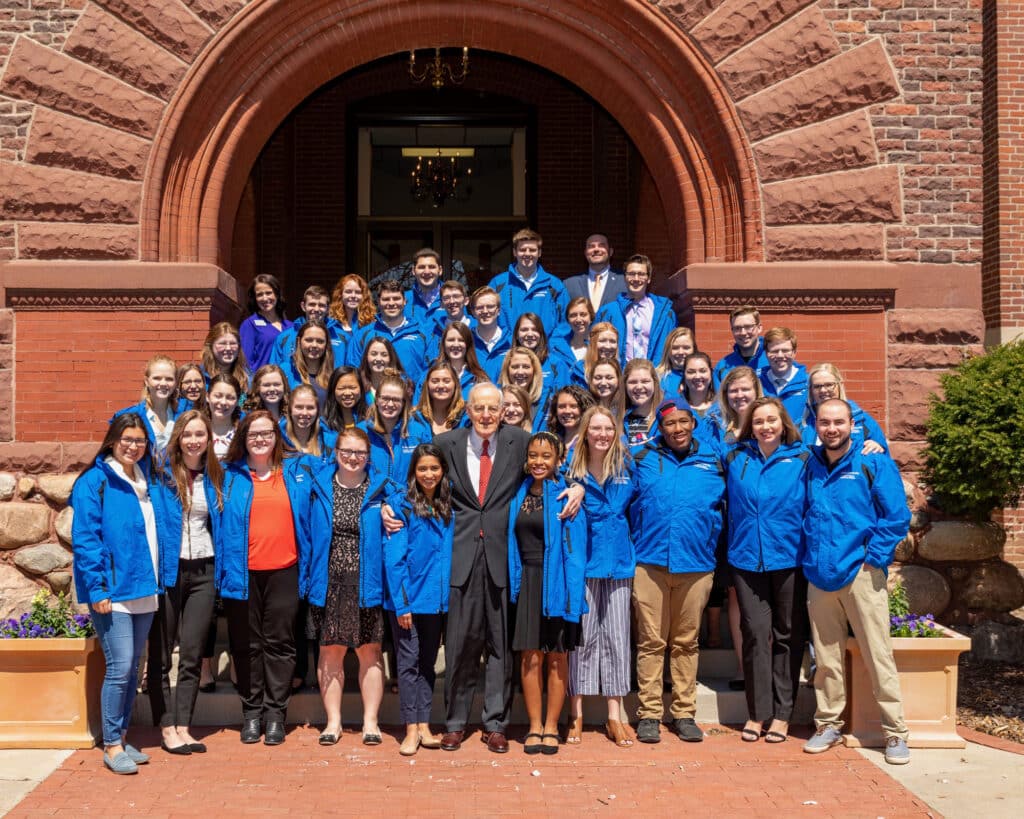
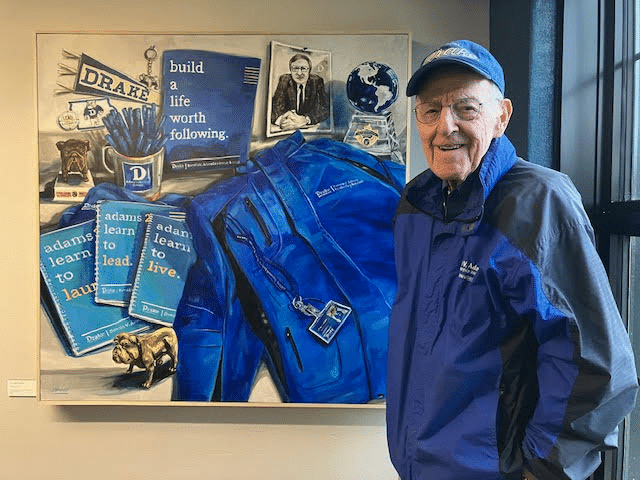
For 38 years, Dr. Donald V. Adams dedicated his career to investing in the lives of Drake University students. From serving as Vice President for Student Life from 1969 to 2007 to later taking on roles in enrollment management and as the executive assistant to the president, he’s well-known at Drake for truly connecting with students.
“A lot of people said his kind of leadership was the kind where you felt noticed and seen and valued, and he wasn’t afraid to have hard conversations,” said Kristin Economos Novotny, the senior director of the Adams Leadership Institute. “He made everyone feel like they were the only person in the room.”
To honor Dr. Adams and his support for students, four Drake alumni created the Adams Leadership Institute. What began as a group of individual programs has evolved into an initiative to equip students with life and leadership skills while perpetuating Dr. Adams’ legacy.
Developing the Program
When Novotny started in 2018, she was tasked with updating the program to remove barriers that could be holding students back from participating.
Novotny was guided by the question, “What if we removed the barrier and the stress of the academic component and the transcript requirement and gave students a chance to actively practice skills in a really low-stakes environment that has to do with leadership outside of class?” she recalled.
She went to her vice president of Student Affairs, who recommended she take a year to review and understand the program.
Throughout the year, Novotny spent a lot of time with Dr. Adams to learn about what he hoped his legacy would be within the institute. She learned that, as a first-generation student himself, Adams was often overwhelmed by the campus experience.
“The only reason he stayed past his original orientation was because of his resident assistant who took him under his wing,” said Novotny. “He still talks about that person, and I think the relationships you make between students, especially in peer leadership roles, changed the trajectory of his life.”
This connection is critical to how the program operates and continues to help provide resources to students. Alumni completely fund the program each year through an endowment and annual giving, making it free for all students accepted. While alumni giving isn’t unusual, Novotny said the support for this program has been unique.
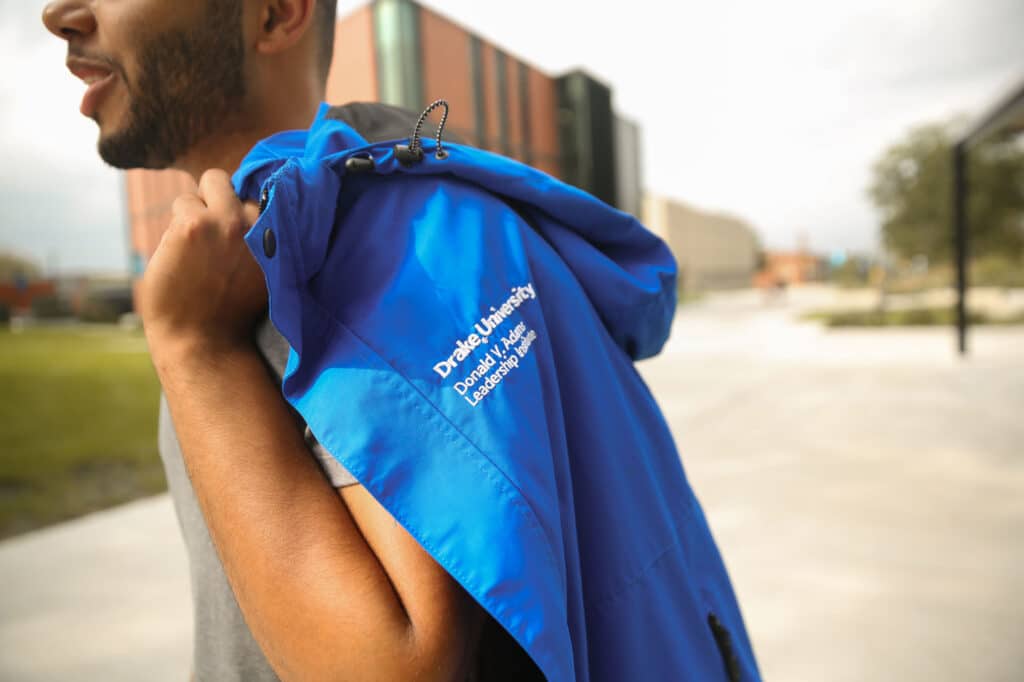
“Students in the program get access to $2,000 worth of supplies, coaching and training materials during their four years, and it’s all paid for by alumni who either give in honor of Don or who’ve been impacted by the institute,” said Novotny. “I’ve never seen a program this well-funded that’s in honor of somebody whose legacy is still living.”
One of Novotny’s goals when reviewing the program was to ensure the coaching and training moved from theory to practice. From this, she created a three-module series to help students live, lead and thrive after college.
“The Leadership Institute used to be an umbrella for all these disparate programs, so let’s make a scaffolded model where they build on one another and we can call back to things they’ve already learned in previous modules,” explained Novotny, regarding the institute’s philosophy.

Learning to Live, Lead and Launch
The program’s courses frame leadership as a life skill to help students become someone people will want to follow. “We say it’s really hard to make a positive change in the causes and communities you care about when you’re somebody other people don’t want to be around,” said Novotny.
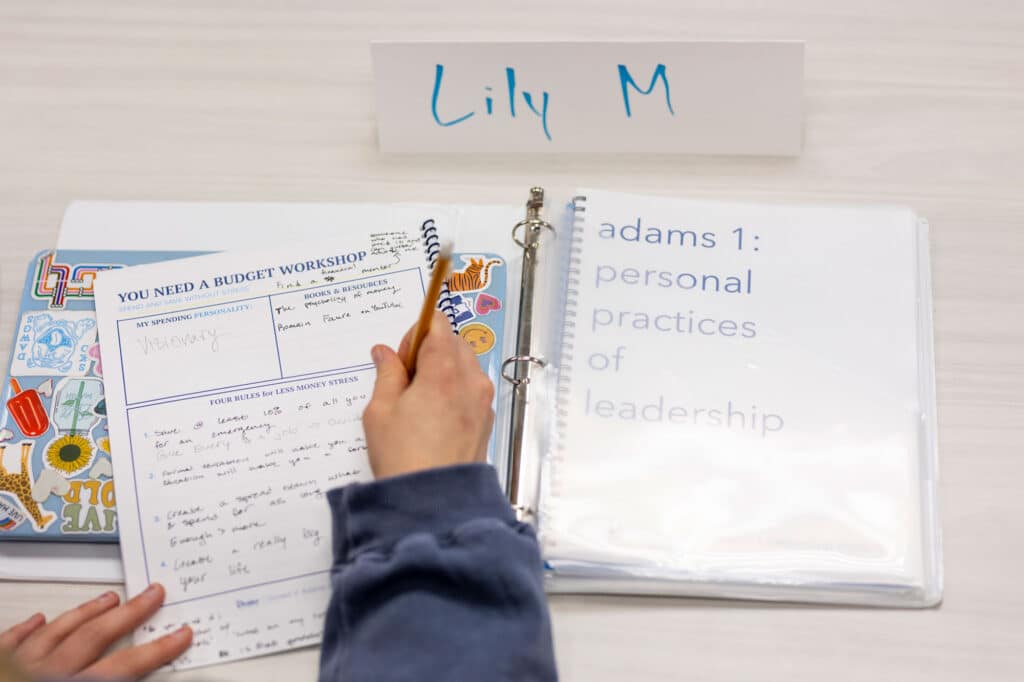
The program starts with Adams One, a semester-long series that teaches first-year students to live like leaders. In this class, students explore how to develop routines, habits and well-being in their own lives to lead others better.
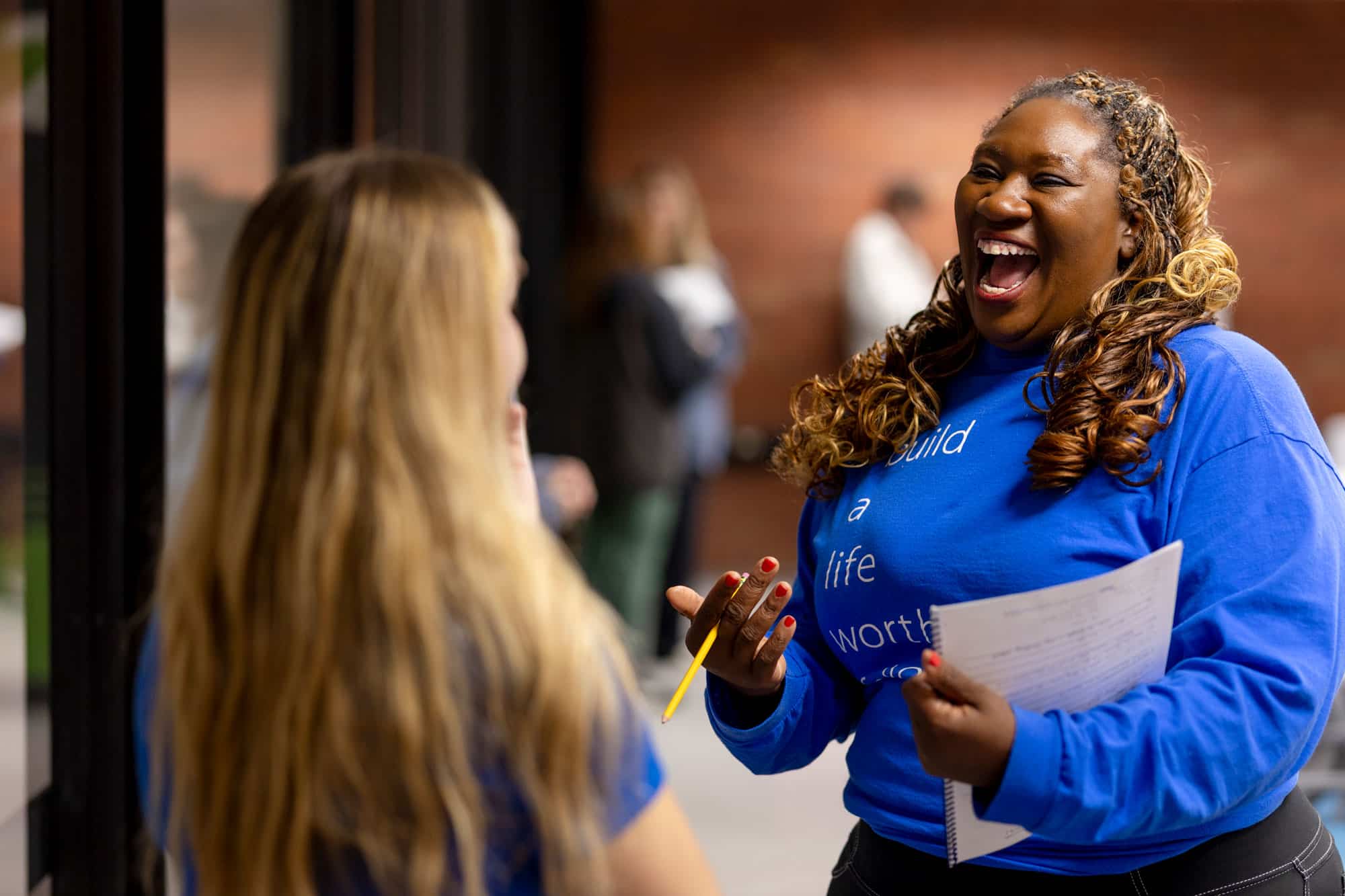
“Our slogan for the institute is to ‘build a life worth following,’ so how do you do that one day at a time?” said Novotny. “Students leave Adams One typically with a really good understanding of basic habits and routines to be able to keep their own life in alignment with what they say matters to them.”
Building on Adams One, Adams Two — or Learn to Lead — is a semester-long series students can take during their sophomore or junior year. With a foundation of basic practices for leading yourself, Novotny said this course acts as a how-to guide.
Students explore how to be organized and build a reputation for great follow-through, how to argue and apologize without losing your temper, how to make decisions without spiraling and second-guessing yourself, and more.
When it comes to practicing public speaking and presentation skills, Novotny said students are much more willing to try and be bad at something when they know no grade is tied to it.
“I often use the analogy of a four-year-old on a soccer field,” explained Novotny. “You would never expect a kid at that age to be great at playing soccer. You can’t expect to be a great public speaker and well-organized and learn how to manage responsibility if you’ve never tried or been taught any kind of structure around how to do it. That part seems to really resonate with them.”
Instead of using case studies and simulating a leadership experience for students, Novotny wanted to explore how to create environments where that naturally plays out. One example is an exercise where Novotny, as an observer, tallies how many times each student speaks in the first hour, then shows the data to the class to illustrate the group dynamic: four students spoke consistently, 11 spoke once, and four students were on their phones.
“Where is the discrepancy between what you say is a priority and what you’re actually doing?” asked Novotny. “Because that’s the space where we’re going to get better as a leader. Students pay attention to that. They’re willing to be called into the conversation if they know that their current and active attention matters.”
Students who complete Adams Two then move to Adams Three, or Learn to Launch, the final course. These two-hour-long weekly seminars help students prepare for leading themselves and others after graduation. They design their next decade, learn how to handle bills and student loans, and explore navigating uncertainty in a world that wants you to know what’s next.
“Many of our students think that once they know what they’re going to do after they graduate, their season of uncertainty is over,” explained Novotny. “We really try to reposition that to say if you’re not waiting for the job, you’re waiting for the relationship or the move or the money. So how do you get better at not knowing?”
Novotny said this final course is highly interactive. Students complete three individual interviews — with a young alum, someone in a location or industry of interest, and a “reach” contact — and gather leadership feedback from 20 people in their lives.
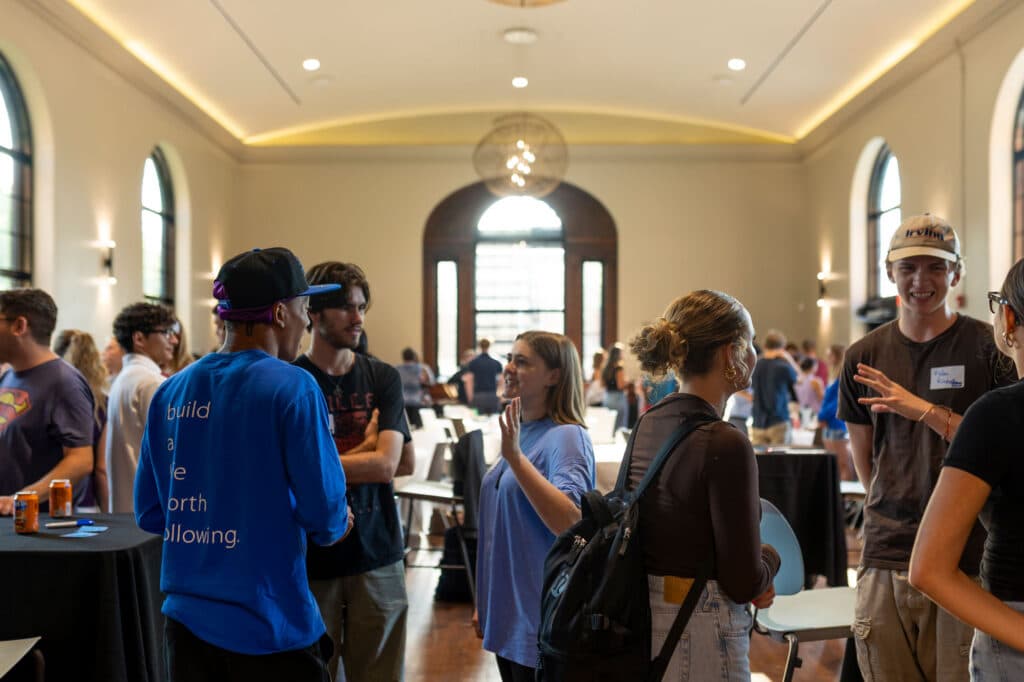
Although the program is not graded, Novotny estimated that it retains about 75% of participants from Adams One through Adams Three. This year’s program has 315 students participating, and 61% of current first year participants cited their acceptance to the Adams Leadership Institute as a factor in their decision to attend Drake University.
Lessons for Student Affairs Leaders
The Adams Leadership Institute offers lessons for institutions seeking to strengthen their own student leadership and career-readiness efforts.
When looking to be more intentional with leadership and career-readiness programs, Novotny said it’s vital to think beyond what students are paying for.
“Focusing on academics is such a priority in any institution, but I think the emotional intelligence gap we often talk about publicly becomes a talking point and we don’t address it in tangible ways,” explained Novotny. “We assume students come in and they know how to use all of our systems and technology, and then we never back it up to actually give them tangible practice to try and get it wrong and try again.”
Another piece of advice from Novotny is strong collaboration with career services staff to connect leadership education more intentionally to career and life skills. Developing relationships with community members and local employers can open up an avenue to ask for advice on how to best equip students after they graduate.
Finally, programs should make the value of participation clear. Students balance academic demands, employment, relationships and extracurricular commitments. A leadership program must offer something useful now, while also preparing students for challenges they may not yet know how to anticipate.
For student affairs leaders, the institute demonstrates how a longstanding campus legacy can evolve into a practical, developmental experience responsive to students’ changing needs. It also underscores the importance of evaluating leadership education not only by the content delivered, but by whether students can use what they learn.
Building a Life Worth Following
The Adams Leadership Institute began as a way to honor a university leader whose influence was measured in the relationships he built and the students he helped stay the course. Today, that legacy continues through a program designed to help students build the skills, judgment and self-awareness to shape their own futures — and positively influence the lives of others.
For institutions working to improve career readiness and student success, it’s vital to remember that preparing students for graduation means helping them navigate uncertainty, build healthy relationships, make responsible decisions and contribute to the communities of which they will become a part.
Student affairs leaders are uniquely positioned to create those opportunities. By connecting leadership development with the everyday skills that support adult life, institutions can help students bridge the distance between knowing what to do and being able to do it.
Ultimately, the measure of a leadership program is what students carry with them when the program ends: the confidence to make difficult decisions, the ability to build trust, the tools to navigate change and the willingness to show up for others.
That’s the lasting promise of the Adams Leadership Institute, and a powerful reminder that preparing students to lead begins with helping them build a life worth following.

Gracie Moore is Assistant Editor for Student Affairs Executive and a lead editor for Campus Rec Magazine, where she covers the people, programs and strategies shaping the campus recreation profession.
Through her work across Peake Media’s higher education brands, Gracie connects with campus leaders to uncover practical ideas, emerging trends and real-world examples of how institutions are supporting students and strengthening the campus experience. Her reporting for Student Affairs Executive expands that focus to the broader priorities facing student affairs leaders, highlighting the strategies and perspectives helping institutions navigate change and advance student success.
Connect with Gracie on LinkedIn or explore her latest articles